
Collapsed Sewer Line Repair Cost
Published sewer line costs (2026)
| Method | Cost per foot | Published job total | Use when |
|---|---|---|---|
| Traditional dig & replace | $50–$250 | $7,500–$30,000 | Severe damage, wrong slope or bellies, or easy open access |
| Trenchless pipe bursting | $150–$190 | $4,000–$20,000 | Pipe collapsed or badly deteriorated; full replacement needed |
| Trenchless pipe lining (CIPP) | $135–$150 | $4,000–$20,000 | Pipe mostly intact with cracks, leaks or moderate roots |
A published trenchless total for a 40–60 foot job is $4,000–$15,000. Sources survey different jobs, so their totals do not always match per-foot math. The calculator uses per-foot rates plus the add-ons you select.
Repairing a collapsed sewer line costs $55–$250 per foot when the crew digs it up, according to Forbes Home. Pipe bursting, which replaces the pipe without a long trench, is $150–$190 per foot. How much of the line has collapsed decides whether you're paying for one section or the whole sewer line replacement cost.
A collapse means part of the lateral, the private pipe from your house to the city main, has caved in or flattened so waste can't get through. It's different from a crack. A cracked pipe still has its shape. A collapsed one doesn't, and that rules out some of the cheaper fixes.
Collapsed sewer line repair cost
| Job | Published range | Source |
|---|---|---|
| Trenched repair of a collapsed line | $55–$250 per foot | Forbes Home |
| Pipe bursting (trenchless) | $150–$190 per foot | This site's sewer table |
| Fix a break or crack in a buried line | $1,100–$4,000, or $75–$500 per foot | Forbes Home |
| Full replacement, about 40 feet | $2,000–$10,000 | HomeGuide |
| Camera inspection to find the collapse | $100–$500 | This site's sewer table |
HomeGuide makes the same point in plain terms: small clogs and roots need only a basic repair, while broken lines and large cracks need partial or full replacement. A collapse sits in that second group.
Why lining usually won't work
CIPP lining, short for cured-in-place pipe, slides a resin-soaked liner into the old pipe and hardens it into a new pipe inside. The old pipe acts as the mold. When a section has caved in, the liner has nothing round to form against, so most crews won't line it. The pipe lining vs pipe bursting guide covers that choice in more detail.
That leaves two real options. A crew can dig at the collapse and lay new pipe, which is the Forbes Home per-foot range above plus whatever it costs to put the yard back. Or they can burst the line, pulling a new pipe through the old path from two small pits. Pipe bursting can usually get past a collapsed spot, though a sharp bend or a wrong slope can stop it.
What usually causes a collapse
Old materials are the most common reason. Orangeburg, a tar-paper pipe used in older homes, tends to flatten. Clay pipe can crack and shift at the joints until a section drops. Cast iron can rust thin. Tree roots, heavy vehicles over the line, and soil that washes out or settles can push any of them over the edge.
Signs your sewer line may have collapsed
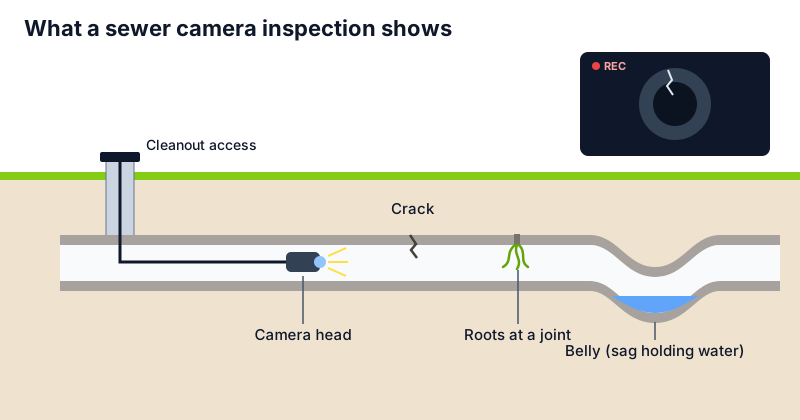
Several drains backing up at the same time, a sewage smell outside, a soggy or sunken strip of yard over the line, and clogs that come back soon after a cleaning all point at the main line. None of them proves a collapse. A camera inspection does, and it also tells the crew how far along the line the damage starts and stops.
Ask for the video and the distances. A plumber who quotes a full replacement without showing you the collapse on camera hasn't given you enough to compare bids.
Worked example
The camera shows a 25-foot collapsed stretch near the street, and the rest of a 50-foot clay line looks sound. The crew bids a trenched section repair through a lawn.
Section repair: 25 × $55 = $1,375 on the low end and 25 × $250 = $6,250 on the high end. Lawn restoration adds about $300–$2,500, which is an approximate figure, and the camera and permit add $200–$1,500. That's $1,875–$10,250 before any location adjustment.
If the video had shown the whole clay line cracking at the joints, bursting all 50 feet would be the better comparison. This site's Midwest example for that job is $7,700–$11,000. The methodology page explains how that estimate is built.
How to save money
- Get a camera inspection before anyone quotes, and ask for the collapse's start and end distances.
- Ask for a section-repair bid and a full-replacement bid on the same visit.
- Get a bursting bid if the collapse is under a driveway, patio, or mature landscaping.
- Don't accept a lining bid for a collapsed section unless the crew explains how the liner will hold its shape.
- Confirm with your city where your responsibility ends before anyone digs near the street.
- Read your insurance policy for a service line endorsement before you file a claim.
Common questions
How much does it cost to fix a collapsed sewer line?
Forbes Home lists $55–$250 per foot for trenched repair of a collapsed line. A short collapse can be one section; a long one is a replacement. HomeGuide lists full replacement at $2,000–$10,000 for about 40 feet.
Can a collapsed sewer pipe be lined?
Usually not. CIPP lining cures a new pipe inside the old one, so the old pipe has to keep its round shape. A collapsed section has nothing for the liner to form against. Pipe bursting or digging and re-laying the pipe are the usual fixes.
What does it cost to fix a break or crack instead of a collapse?
Forbes Home puts fixing a break or crack in a buried line at $1,100–$4,000, or $75–$500 per foot. A cracked pipe that still holds its shape has more options, including lining.
How do I know if my sewer line has collapsed?
Signs include several drains backing up at once, a sewage smell outside, a soggy or sunken strip of yard over the line, and clogs that come back soon after a cleaning. Only a camera inspection, at $100–$500, confirms a collapse and shows where it is.
Does homeowners insurance cover a collapsed sewer line?
Often not, if the collapse came from age, roots, or soil movement, which standard policies tend to exclude. A service line endorsement is about $30–$40 a year in the published data. Ask your insurer in writing before you assume a claim will pay.
Sources
See how these ranges are built on the methodology page.