
How Long Does Sewer Line Replacement Take?
Published sewer line costs (2026)
| Method | Cost per foot | Published job total | Use when |
|---|---|---|---|
| Traditional dig & replace | $50–$250 | $7,500–$30,000 | Severe damage, wrong slope or bellies, or easy open access |
| Trenchless pipe bursting | $150–$190 | $4,000–$20,000 | Pipe collapsed or badly deteriorated; full replacement needed |
| Trenchless pipe lining (CIPP) | $135–$150 | $4,000–$20,000 | Pipe mostly intact with cracks, leaks or moderate roots |
A published trenchless total for a 40–60 foot job is $4,000–$15,000. Sources survey different jobs, so their totals do not always match per-foot math. The calculator uses per-foot rates plus the add-ons you select.
HomeGuide lists 1–5 days to replace or repair a sewer line, depending on length and what sits in the way. Trenchless work is the short end of that band. A traditional dig is the long end, and Angi says that dig can run more than a week. Prices for the job itself are on the sewer line replacement cost page. This page is the calendar.
You usually can stay in the house. You can't send water down the drains while the lateral is open. No toilets, no laundry, no showers until the new pipe is connected and tested.
How long sewer line replacement takes by method
| Work | Published duration | Source |
|---|---|---|
| Repair or replacement, any method | 1–5 days | HomeGuide (December 22, 2025) |
| Trenchless replacement | 1–3 days | HomeAdvisor |
| Trenchless lining, many jobs | One day; smaller jobs a few hours | Angi (July 2026) |
| Traditional dig | Can take over a week | Angi; not a separate HomeGuide number |
| Drain field, if you are on septic | 3–7 days | HomeGuide |
HomeGuide's 1–5 day range already includes trenchless work and digging. It says trenchless replacements take less time than trenching. We'd rather leave that blank than print a dig-only day count HomeGuide never published.
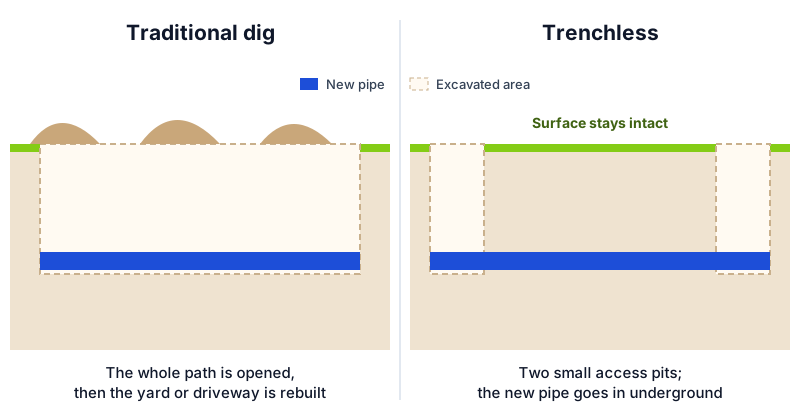
Trenchless sewer line replacement uses two small pits, or a cleanout, instead of a trench across the yard. Pipe bursting pulls in HDPE, a flexible plastic pipe, and breaks the old pipe outward. Lining, CIPP, cures a resin liner inside a pipe that is still round. Bursting doesn't wait on a cure. Lining does.
What those days don't include
Permits, city inspections, and utility locates sit on top of crew time. Call 811 before anyone digs so gas, electric, and water get marked. Weather, a frozen trench, or work in the street can add days the bid didn't show as “pipe work.” Angi notes that a traditional job may close a street for equipment.
A camera inspection at $100–$500 should happen before the method is chosen. Doing it after the trench is open is how a lining plan turns into a multi-day dig.
Restoration is its own clock. The pipe can be in use while the driveway patch is still on a contractor's schedule. Sewer line repair is shorter when the camera shows one joint instead of a dead run.
Living in the house
You'll lose your drains while the crew is working. The permit wait before that doesn't affect them. Bottled water, a paused dishwasher, and a neighbor's laundry room get you through a one-day lining job. A dig that runs several days is harder. Ask the bidder, in writing, when the line will be usable again and whether overnight caps are part of the plan.
If sewage has already entered the house, cleanup is a different duration. HomeGuide puts a simple sewage cleanup at 1–3 days and a large restoration at 1–2 weeks. That clock starts when the water got in. It doesn't wait for the new lateral to be finished.
Worked example
A 50-foot suburban lateral. The camera shows a collapsed clay run, which rules out lining, so the crew plans to burst it.
HomeAdvisor's trenchless window is 1–3 days of crew time. HomeGuide's overall band is still 1–5 days. Put both on the bid: “pipe work, 1–3 days; permit and inspection not included.”
If the same house had needed a trench under a driveway, Angi is the source for “over a week,” and restoration would continue after the toilets worked again. The dollars for that 50-foot bursting job, with a camera and a permit in a Midwest suburb, are about $7,700–$11,000. Time and money are separate lines.
How to save money
- Book the camera before you approve a method, so you aren't changing from lining to a dig mid-week.
- Ask for a written schedule: start day, day the drains work, day restoration ends.
- Call 811 early. Locates that arrive after the crew does are dead time you still pay for.
- If the city owns the stretch under the street, get that in writing so you aren't waiting on the wrong permit.
- Don't treat “one day” as a promise unless the bid names lining or bursting and the path is already filmed.
Common questions
How long does trenchless sewer replacement take?
HomeAdvisor lists 1–3 days for most trenchless replacements. Angi (July 2026) says a lining job can be done in a single day, and smaller lining jobs in a few hours. Bursting still needs two access pits. HomeGuide's overall 1–5 day band includes both trenchless work and digging.
How long does a traditional sewer line dig take?
HomeGuide doesn't print a separate dig-only number. Its 1–5 day range covers replacement or repair, and it says trenchless work takes less time than trenching. Angi says a traditional replacement can take over a week. Restoration of a lawn or driveway can continue after the pipe is in.
Can I live in the house during the work?
You can usually stay, but you can't send water down the drains while the lateral is open. Angi notes that during a dig you lose toilets, sinks, and showers until the new line is connected. Plan on bottled water and a pause on laundry. Ask the crew when the line will be usable again, in writing.
What delays a sewer line replacement?
Permits, city inspections, utility locates (call 811 before anyone digs), weather, and work in the street or a parking strip. Those waits sit on top of the 1–5 crew days. A camera inspection, at $100–$500, should happen before the method is chosen. Once the trench is open, it's too late.
Sources
See how these ranges are built on the methodology page.