
Cost to Connect (Hook Up) to City Sewer
Published sewer line costs (2026)
| Method | Cost per foot | Published job total | Use when |
|---|---|---|---|
| Traditional dig & replace | $50–$250 | $7,500–$30,000 | Severe damage, wrong slope or bellies, or easy open access |
| Trenchless pipe bursting | $150–$190 | $4,000–$20,000 | Pipe collapsed or badly deteriorated; full replacement needed |
| Trenchless pipe lining (CIPP) | $135–$150 | $4,000–$20,000 | Pipe mostly intact with cracks, leaks or moderate roots |
A published trenchless total for a 40–60 foot job is $4,000–$15,000. Sources survey different jobs, so their totals do not always match per-foot math. The calculator uses per-foot rates plus the add-ons you select.
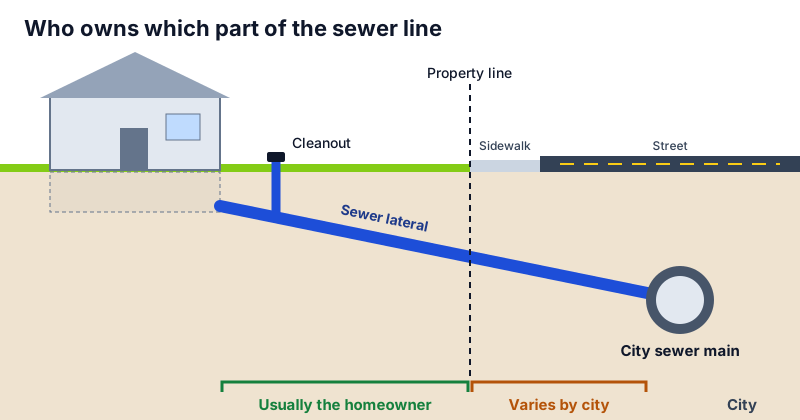
Connecting, or hooking up, a house to city sewer has two separate bills: the connection fee your city or utility charges, and the private pipe a plumber lays from the house to the main. This guide covers both. If you already have a city connection and the pipe has failed, the sewer line replacement cost guide is the better starting point.
Cost to hook up to city sewer
HomeGuide lists the cost to hook up to a city sewer at $1,000–$15,000, with a national average of about $8,000. It says that price depends on pipe material, house size, and the city's current capacity, and that it varies widely between towns. The same range applies whether your town calls it a city or a public sewer.
That connection price doesn't include the new private sewer line. HomeGuide prices the line separately:
| Item | Published range | Source |
|---|---|---|
| City sewer connection | $1,000–$15,000, about $8,000 on average | HomeGuide |
| New sewer line, installed | $40–$180 per foot | HomeGuide |
| New sewer line, up to 40 feet | $1,600–$7,200 | HomeGuide |
| Trenching | $5–$12 per foot | HomeGuide |
| Directional boring | $10–$30 per foot | HomeGuide |
| Plumbing permit | $30–$500 | HomeGuide |
Directional boring drills a path underground, so a driveway or lawn can stay mostly intact. HomeGuide prices it higher per foot than open trenching. The sewer line installation cost guide breaks down the new line itself.
Switching from septic to sewer
HomeGuide puts a septic-to-sewer conversion at about $3,000–$15,000. It lists three steps: decommission the tank, install a new main sewer line, and connect to the local system.
Decommissioning means taking the tank out of service, either by removing it or by filling it, often with sand. Before that, the tank is usually pumped. Septic pumping is $300–$700 in HomeGuide's septic data. Some areas also require a permit to abandon the old leach field; HomeGuide lists that permit at $100–$250.
If your septic system has already failed, compare this with fixing it. The septic system replacement cost guide covers tank and drain field prices.
Do you have to connect?
It depends on where you live. HomeGuide says connecting isn't required in general and that a septic system remains an option in remote areas. Some towns, though, require houses to connect once a public sewer main is available nearby. Ask your city or utility three questions before you get bids:
- Is connection required, and by when?
- What is the connection fee for my lot, and what does it include?
- Are there grants, payment plans, or assessments for this project?
HomeGuide also notes you need permission from the local authority before you connect. The who is responsible for the sewer line guide explains where your pipe usually ends and the city's begins.
How long it takes
HomeGuide says connecting to a city sewer takes 1–5 days, depending on obstacles and the digging method. Permits and inspections can add waiting time. The how long sewer line replacement takes guide breaks down the same kinds of delays.
Worked example
A house on septic sits 60 feet from a new sewer main. The plumber will trench and lay a new line.
New line: 60 × $40 = $2,400 on the low end and 60 × $180 = $10,800 on the high end. Septic pumping before decommissioning adds $300–$700, and a plumbing permit adds $30–$500.
That is $2,730–$12,000 before the city's connection fee, which HomeGuide lists at $1,000–$15,000. The fee is the number to get from your city first, because it can be larger than the pipe work. The methodology page explains how this site uses published ranges.
How to save money
- Get the connection fee in writing from the city before you collect plumber bids.
- Ask whether the city's project includes the part of the line under the street.
- Ask about grants, payment plans, or assessment terms for required connections.
- Compare an open trench with directional boring if a driveway or mature landscaping is in the path.
- Confirm who pumps and decommissions the septic tank, and that it is in the bid.
Common questions
How much does it cost to hook up to city sewer?
HomeGuide lists $1,000–$15,000, with a national average of about $8,000. That is the connection itself. The new line from the house is extra, at $40–$180 per foot. Your city sets the fee, so ask it directly.
How much does it cost to convert from septic to sewer?
HomeGuide puts a septic-to-sewer conversion at about $3,000–$15,000. The steps are decommissioning the tank, installing a new main sewer line, and connecting to the local system. Pumping the tank first is $300–$700.
Do I have to connect to city sewer?
It depends on your town. HomeGuide says connection isn't required in general, but some towns require it once a public sewer main is available near your house. Ask your city or utility whether connection is required, by when, and whether grants or payment plans exist.
How long does it take to connect to city sewer?
HomeGuide says 1–5 days, depending on obstacles and the digging method. Permits, inspections, and landscaping removal can add time. Trenchless boring is usually faster than digging a long trench.
Sources
See how these ranges are built on the methodology page.