
Sewer Line Belly Repair Cost
Published sewer line costs (2026)
| Method | Cost per foot | Published job total | Use when |
|---|---|---|---|
| Traditional dig & replace | $50–$250 | $7,500–$30,000 | Severe damage, wrong slope or bellies, or easy open access |
| Trenchless pipe bursting | $150–$190 | $4,000–$20,000 | Pipe collapsed or badly deteriorated; full replacement needed |
| Trenchless pipe lining (CIPP) | $135–$150 | $4,000–$20,000 | Pipe mostly intact with cracks, leaks or moderate roots |
A published trenchless total for a 40–60 foot job is $4,000–$15,000. Sources survey different jobs, so their totals do not always match per-foot math. The calculator uses per-foot rates plus the add-ons you select.
Fixing a belly in a sewer line costs about $1,500–$3,000 for one bellied section in Fixr's data. If the whole line has to be dug and re-laid, the published dig rate is $50–$250 per foot before the yard is restored.
A belly is a sag in a sewer pipe. Instead of sloping steadily toward the street, part of the line dips, and water, paper, and solids settle in the low spot. It is one of the problems that changes the repair method, and so the final sewer line replacement cost.
How much it costs to fix a belly in a sewer line
Fixr is the only established cost site we found that publishes a belly-specific price. Its problem table lists replacing a bellied section at $1,500–$3,000, depending on the size of the pipe being replaced. For a long belly, or a line with other damage, the general per-foot rates apply instead.
| Job | Published range | What it covers |
|---|---|---|
| Replace a bellied section | $1,500–$3,000 | Fixr problem table |
| Spot repair, cracked section | $600–$1,050 | A short repair, not a re-graded line |
| Dig and replace | $50–$250 per foot | Pipe work before yard restoration |
| Lawn restoration after a dig | about $300–$2,500 | Approximate |
| Camera inspection | $100–$500 | Finds and measures the belly |
The Fixr range fits a short belly that can be opened and re-set. It isn't a quote for an entire line.
What causes a belly
Fixr describes the usual cause: the soil around the pipe softens or settles, and the pipe presses down into it. Poor bedding when the line was first laid, washouts from a leak, and heavy loads over the pipe can do the same.
A small belly may only collect a little water. A deep one holds waste and turns into a repeat clog. A camera crew can usually see standing water in the pipe and measure where the dip starts and ends. Ask for those distances in writing.
Why trenchless methods often can't fix it
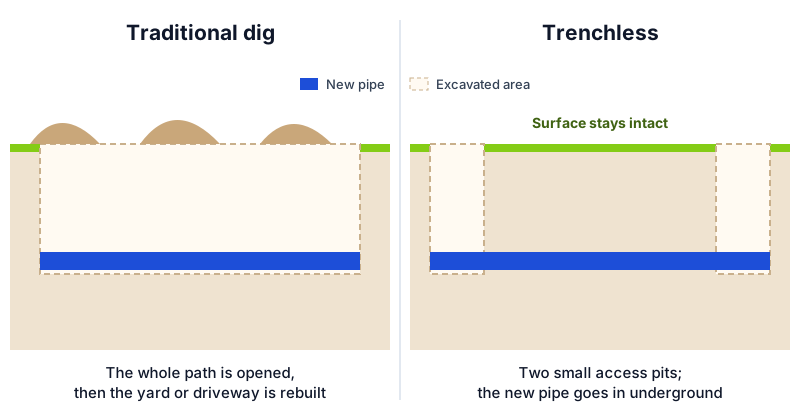
CIPP lining cures a new pipe inside the old one. It follows the old pipe's shape, so a liner in a belly is a new pipe with the same sag. Pipe bursting pulls a new pipe along the old path, and it also tends to follow the existing grade. The trenchless sewer line replacement guide lists a belly as one of the cases where trenchless is the wrong tool.
The usual fix is to dig at the belly, re-compact or rebuild the bedding under the pipe, and re-lay that section at the correct slope. If the camera shows bellies in several places, or the whole line is old clay or Orangeburg, a full dig and replacement may be the cleaner bid.
Is a belly covered by insurance?
Often not. Standard homeowners policies tend to exclude settling, wear, and gradual damage, which is how most bellies form. A service line endorsement is a separate add-on, about $30–$40 a year in the published data. Check the wording on your own policy. The homeowners insurance and sewer line guide covers what to ask your insurer.
Worked example
A 55-foot clay lateral on a suburban lot in the Mountain / Southwest region. The camera shows two bellies and cracked joints along most of the run, so the plumber bids a full dig instead of a section repair.
Pipe work is 55 × $50 = $2,750 on the low end and 55 × $250 = $13,750 on the high end. The camera, permit, and lawn restoration add $500–$4,000. With the location factor of ×1.00–×1.10, the rounded estimate is $3,300–$19,500.
If the same video had shown one short belly in an otherwise sound PVC line, the Fixr section range, $1,500–$3,000, would be the better comparison. The methodology page explains the location factors.
How to save money
- Get the belly's start, end, and depth from the camera report before anyone bids.
- Ask whether the bid repairs one section or replaces the whole line, and why.
- Be wary of a lining bid for a belly unless the plumber explains how the slope will change.
- Ask what bedding material will go under the new pipe.
- Ask for a camera run after the repair to confirm the water no longer pools.
Common questions
How much does it cost to fix a belly in a sewer line?
Fixr's problem table lists $1,500–$3,000 to replace a bellied section, depending on pipe size. If the line has several bellies or other damage, the general dig rate of $50–$250 per foot, plus restoration, is the better guide.
Can a belly be fixed without digging?
Usually not. CIPP lining cures a new pipe inside the old one and keeps its shape, sag included. Pipe bursting tends to follow the existing path and grade. Fixing the slope normally means opening the ground at the belly, rebuilding the bedding, and re-laying the pipe.
Is a sewer belly covered by homeowners insurance?
Often not, because most bellies come from settling and gradual soil movement, which standard policies tend to exclude. A service line endorsement is about $30–$40 a year in the published data. Read your policy form and ask your insurer in writing.
Do I have to fix a small belly?
Not always. A shallow belly that holds a little water and causes no backups may be monitored. A deep belly that collects waste becomes a repeat clog. Ask the camera operator how deep the standing water is and how long the sag runs, then decide with a plumber's written recommendation.
Sources
See how these ranges are built on the methodology page.