
Tree Roots in a Sewer Line: Removal and Repair Cost
Published sewer line costs (2026)
| Method | Cost per foot | Published job total | Use when |
|---|---|---|---|
| Traditional dig & replace | $50–$250 | $7,500–$30,000 | Severe damage, wrong slope or bellies, or easy open access |
| Trenchless pipe bursting | $150–$190 | $4,000–$20,000 | Pipe collapsed or badly deteriorated; full replacement needed |
| Trenchless pipe lining (CIPP) | $135–$150 | $4,000–$20,000 | Pipe mostly intact with cracks, leaks or moderate roots |
A published trenchless total for a 40–60 foot job is $4,000–$15,000. Sources survey different jobs, so their totals do not always match per-foot math. The calculator uses per-foot rates plus the add-ons you select.
Removing tree roots from a sewer line costs $100–$600, according to Fixr. Roots get in through cracks and loose joints, then grow into a mat that catches paper and grease. Fixing the opening they came through is the bigger bill, and that part follows the same rates as the main sewer line replacement cost guide.
Tree root removal cost from a sewer line
Three published sources price root removal. They don't use the same survey, so they are shown side by side instead of averaged.
| Job | Published range | Source |
|---|---|---|
| Remove tree roots from a sewer line | $100–$600 | Fixr |
| Tree-root clog, problem table | $100–$800 | Fixr |
| Remove tree roots, snaking to hydro jetting | $300–$1,100 | Forbes Home |
| Root removal added to a cleaning bill | $200–$600 or more | HomeGuide |
| Rodding a sewer line | $150–$600 | Fixr |
| Chemical root treatment | $50–$300 | HomeGuide |
| Camera inspection to find the roots | $100–$500 | This site's sewer table |
Forbes Home puts snaking at the low end of its range and hydro jetting at the high end. HomeGuide describes the usual tool as a heavy-duty auger or a hydro jet with a cutting head.
How roots are removed
A mechanical cutter, also called rodding or snaking, spins a blade through the pipe and chops the roots. It's the cheaper option, but it can leave root stubs behind, along with the gap they grew through.
Hydro jetting sprays water at high pressure, usually with a cutting nozzle. It cleans the pipe wall more completely, which is why it sits at the top of the Forbes range. It still doesn't close a crack.
Chemical treatment uses a product that kills root growth inside the pipe. HomeGuide notes it is less common for main lines. Fixr lists annual chemical treatment as a way to slow regrowth after the line is cleared or repaired. Think of it as upkeep, because the crack is still there.
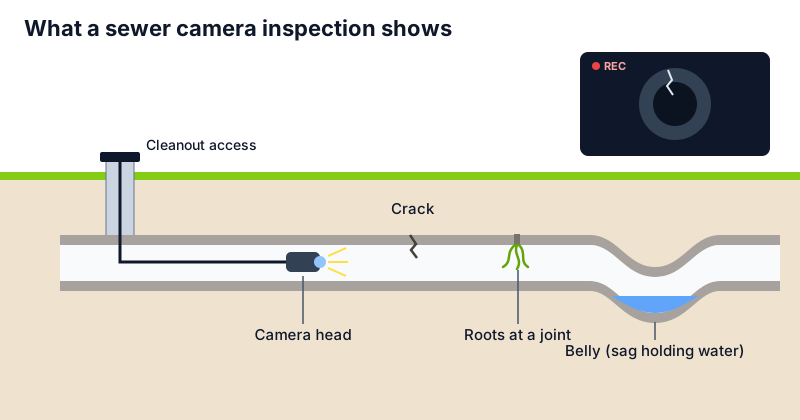
Why roots come back
Roots follow moisture. A crack or an open joint leaks a little water into the soil, and the tree grows toward it. Cutting the roots clears the clog, but the crack stays. Fixr is blunt about this: once roots are inside, clearing the clog often ends with replacing the damaged pipe.
Older materials are the usual target. Clay sewer pipe has many short joints, Orangeburg can lose its shape, and cast iron can crack as it corrodes. A camera run after the roots are cut tells you which case you have.
When removal isn't enough
Ask for the video before you agree to a third cleaning. Most cases land in one of three places.
- A few roots at one joint, and the pipe is still round. Cut the roots, then consider a spot repair, listed at $600–$1,050.
- Roots at many joints, but the pipe is still round. CIPP lining, a resin liner cured inside the old pipe, seals the joints the roots used. Lining is $135–$150 per foot.
- The pipe is cracked, offset, or collapsed. Pipe bursting at $150–$190 per foot, or a dig at $50–$250 per foot before restoration.
If you are paying for root cutting once or twice a year, add it up. Several years of cleanings can approach the price of a liner that ends the problem.
Worked example
A 45-foot clay lateral on a suburban lot in the Northeast. The drains slow down every spring. The plumber cuts roots for $100–$600 and films the line. The video shows roots at most joints, but the pipe is still round, so the crew bids lining.
Pipe work is 45 × $135 = $6,075 on the low end and 45 × $150 = $6,750 on the high end. The camera and permit add $200–$1,500. The Northeast factor is ×1.15–×1.30, so the rounded estimate is $7,200–$10,700.
Compare that with cutting roots every year at the Forbes Home range, $300–$1,100. The liner costs more up front, but no number of cleanings will close the joints. The methodology page explains how the location factor is applied.
How to save money
- Ask for a camera run the first time roots are cut. Waiting until the third visit wastes money.
- Ask whether the price is snaking or hydro jetting, since Forbes Home prices them at opposite ends.
- Keep the video. It is the basis for comparing a spot repair, a liner, and a replacement.
- Find out which tree is involved before you plant another one over the lateral.
- Read your insurance form before you assume root damage is covered; the [homeowners insurance](/does-homeowners-insurance-cover-sewer-line/) guide explains why it often isn't.
Common questions
How much does it cost to remove tree roots from a sewer line?
Fixr lists $100–$600 for root removal. Forbes Home lists $300–$1,100, with snaking at the low end and hydro jetting at the high end. HomeGuide adds $200–$600 or more to a cleaning bill when roots are the cause.
Will tree roots come back after they are cut?
Often, yes. Roots grow toward the moisture leaking from a crack or a loose joint, and cutting them doesn't close that opening. Fixr lists annual chemical treatment as a way to slow regrowth. HomeGuide prices chemical treatment at $50–$300. A lasting fix seals or replaces the pipe.
Is hydro jetting or snaking better for roots?
Snaking, or rodding, cuts a path through the roots and is the cheaper option. Hydro jetting with a cutting nozzle cleans the pipe wall more completely and costs more. Neither repairs the joint the roots used. Ask the plumber to film the line after either one so you can see what is left.
Can pipe lining stop tree roots?
Lining can seal the joints and small cracks roots use, if the old pipe is still round. CIPP lining is $135–$150 per foot. A collapsed or badly offset pipe usually needs bursting or a dig instead. The camera video decides which method fits.
Sources
See how these ranges are built on the methodology page.