
Is a Sewer Scope Worth It Before Buying a House?
Published sewer line costs (2026)
| Method | Cost per foot | Published job total | Use when |
|---|---|---|---|
| Traditional dig & replace | $50–$250 | $7,500–$30,000 | Severe damage, wrong slope or bellies, or easy open access |
| Trenchless pipe bursting | $150–$190 | $4,000–$20,000 | Pipe collapsed or badly deteriorated; full replacement needed |
| Trenchless pipe lining (CIPP) | $135–$150 | $4,000–$20,000 | Pipe mostly intact with cracks, leaks or moderate roots |
A published trenchless total for a 40–60 foot job is $4,000–$15,000. Sources survey different jobs, so their totals do not always match per-foot math. The calculator uses per-foot rates plus the add-ons you select.
A sewer scope is a camera run through the house's sewer lateral, the private pipe from the house to the city main. A standard home inspection usually doesn't look inside that pipe. The scope is a small fee next to the sewer line replacement cost you could inherit if the line is broken.
Sewer scope cost before you buy
HomeGuide publishes four prices for the same kind of visit. Which one you pay depends on who runs the camera and how the crew gets into the pipe.
| Situation | Published range | Source |
|---|---|---|
| Added to a home inspection | $100–$250 | HomeGuide |
| Camera inspection, home has a cleanout | $125–$500, about $280 on average | HomeGuide |
| Camera inspection, no cleanout | $175–$750 | HomeGuide |
| Full home and sewer camera inspection | $400–$750 | HomeGuide |
A cleanout is a capped pipe that opens onto the lateral. Without one, HomeGuide says the plumber pulls a toilet to get the camera in, which is why that row costs more. The sewer camera inspection cost guide covers the same camera visit for homeowners who already live in the house.
Is a sewer scope worth it?
Compare the fee with what the camera can find. Pipe bursting is $150–$190 per foot. A dig is $50–$250 per foot before the yard is restored. Even a short line is thousands of dollars. A scope added to an inspection is a few hundred at most.
The scope is most useful when:
- The house is older. Clay, cast iron, and Orangeburg laterals are common in older homes. Orangeburg is a tar-paper pipe that can flatten over time.
- Large trees stand between the house and the street. Their roots enter through joints and cracks.
- The house sat empty for a while. A vacant house with little water use can hide a slow line until you move in.
- The seller mentions past backups or a recent drain cleaning. A cleaning clears the pipe. It doesn't repair it.
It matters less on a newer house with a PVC lateral and no history of problems. Many buyers still order it, because the fee is small and the video is the only way to see the pipe.
What the camera can show
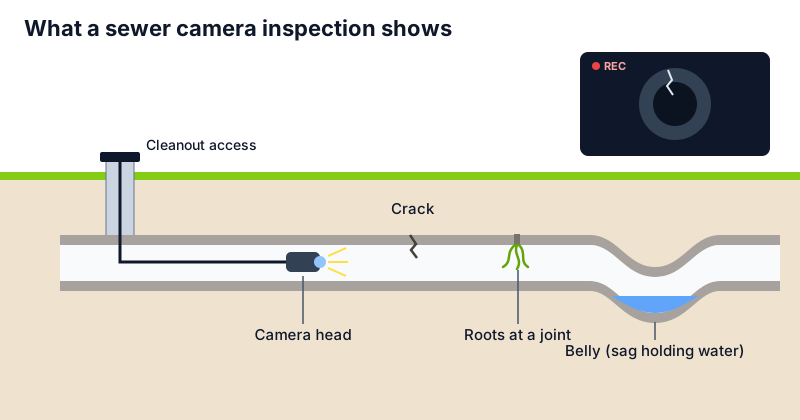
Common findings are roots at joints, cracks, offset joints, scale inside cast iron, and a belly. A belly is a sag where waste and water sit. Ask the operator to state the pipe material, the distance to each problem, and whether the camera reached the city connection. A scope that stops halfway is a partial answer.
Ask for the video file itself. A one-page summary leaves too much out. You will want it if you negotiate or get repair bids.
If the scope finds a problem
The video gives you something specific to bring to your agent. Common next steps are asking the seller to repair, asking for a credit, or getting a repair bid before you decide. Your agent and your contract set the rules. This site doesn't give legal or real estate advice.
Get a plumber's bid that names the method. Roots at a few joints in a round pipe might be a cleaning and a tree root repair. A collapse or a belly is usually a replacement. Also check where your ownership ends. The who is responsible for the sewer line guide explains why the city's part of the pipe isn't your bill.
Worked example
A buyer is closing on a 1950s house with a 60-foot clay lateral and two large maples in the front yard. Adding the scope to the home inspection costs $100–$250.
The video shows a cracked section near the street. If the crew bursts the full line, pipe work alone is 60 × $150 = $9,000 on the low end and 60 × $190 = $11,400 on the high end, before a permit or a location factor. The methodology page explains how those adjustments are applied.
At the top of the scope range, $250, the fee is a small fraction of the low replacement figure. That ratio is the case for the scope.
How to save money
- Add the scope to the home inspection, where HomeGuide lists the lowest price.
- Ask whether the house has a cleanout before you book, since a missing one raises the price.
- Request the full video and the distance to each defect.
- Confirm the camera reached the city connection.
- Get a written repair bid before you agree to a credit amount.
Common questions
How much does a sewer scope cost?
HomeGuide lists $100–$250 when the scope is added to a home inspection. A standalone camera inspection is $125–$500 with a cleanout and $175–$750 without one, because the plumber may need to pull a toilet to get the camera in.
Is a sewer scope part of a home inspection?
Usually not. A standard home inspection looks at visible plumbing. It doesn't see inside the buried lateral. HomeGuide prices the scope as an add-on to the inspection. Ask your inspector whether they offer it or who they recommend.
What does a sewer scope look for?
The camera records the inside of the lateral, the private pipe from the house to the city main. Common findings are tree roots, cracks, offset joints, scale in cast iron, a flattened Orangeburg pipe, and bellies, which are sags where waste sits. Ask for the distance to each problem and the full video file.
What if the sewer scope finds a problem?
Get a written repair bid that names the method, then talk to your agent about your options. Buyers commonly ask for a repair or a credit. Your contract and local practice set the rules, and this site doesn't give real estate or legal advice.
Sources
See how these ranges are built on the methodology page.