
Sewer Pipe Lining Cost (CIPP Relining)
Published sewer line costs (2026)
| Method | Cost per foot | Published job total | Use when |
|---|---|---|---|
| Traditional dig & replace | $50–$250 | $7,500–$30,000 | Severe damage, wrong slope or bellies, or easy open access |
| Trenchless pipe bursting | $150–$190 | $4,000–$20,000 | Pipe collapsed or badly deteriorated; full replacement needed |
| Trenchless pipe lining (CIPP) | $135–$150 | $4,000–$20,000 | Pipe mostly intact with cracks, leaks or moderate roots |
A published trenchless total for a 40–60 foot job is $4,000–$15,000. Sources survey different jobs, so their totals do not always match per-foot math. The calculator uses per-foot rates plus the add-ons you select.
Sewer pipe lining costs $80–$250 per foot for cured-in-place pipe (CIPP), according to both HomeGuide and Fixr. Forbes Home puts a whole lining job at $3,000–$12,000. On most homes that's a good deal less than digging up the yard, which is why lining comes up early in any talk about sewer line replacement cost.
Lining, also called relining, fixes the pipe from the inside. A crew pulls a flexible tube soaked in resin into the old line, inflates it so it presses against the walls, and lets it harden. What's left is a new pipe inside the old one. Fixr notes that cured-in-place lining usually needs just one access point, so there’s no trench across the yard.
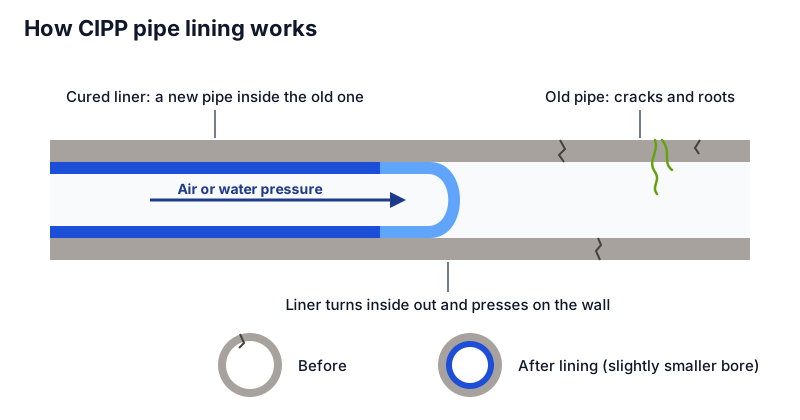
Pipe lining cost per foot
| Method | Published cost per foot | Source |
|---|---|---|
| Cured-in-place pipe (CIPP) | $80–$250 | HomeGuide and Fixr |
| Spin-cast lining (resin sprayed inside) | $80–$250 | HomeGuide |
| Internal pipe coating | $50–$250 | Fixr |
| Pull-in-place liner | $60–$200 | Fixr |
| Pipe relining, all methods | $50–$250 | Fixr |
| Camera inspection before lining | $125–$500 | HomeGuide |
This site's calculator uses a narrower $135–$150 per foot for lining, taken from trenchless contractors' own price pages. That sits in the middle of the HomeGuide and Fixr ranges. The methodology page lists every source behind it.
What moves the price
Length matters most, since lining is priced by the foot. A 30-foot run and a 90-foot run are very different bills even with the same crew.
Pipe size comes next. A wider pipe takes a bigger liner and more resin. The main line from a house is usually small, but a shared line or a commercial lateral isn't.
Branch connections add work. Where a side drain joins the line, the liner seals over the opening, and the crew has to cut it back open with a robotic cutter. More connections mean more time.
Prep work counts too. The pipe has to be clean before the liner goes in. Roots and scale come out first, often with hydro jetting, and that may be billed separately. Ask whether the bid includes it.
When lining won't work
Lining needs a pipe that still holds its shape. It can't fix:
- a pipe that has caved in, which is covered in collapsed sewer line repair cost
- a sag where water and waste sit, called a belly, because the liner follows the old slope
- joints that have shifted far out of line
- a pipe that's too small for the flow your house needs
Forbes Home makes the same point: if the line has lost its position or was installed at the wrong pitch, trenching is the better fix. In those cases, compare lining with pipe bursting, which pulls a brand-new pipe through the old path. The pipe lining vs pipe bursting guide covers that choice.
Where lining does fit is cracks, leaking joints, root entry, and corrosion in pipe that's still round. Cast iron, clay and older PVC are all common candidates.
How long a liner lasts
Forbes Home says newer lining and pipe materials can last more than 50 years. That's a general claim about the materials and doesn't guarantee your job. What protects you is the written warranty in the bid. Ask how many years it covers, whether it covers labor as well as the liner, and who honors it if the company closes.
Most lining jobs take about a day, HomeGuide says, with limits on water use while the resin cures.
Worked example
A camera shows a 50-foot clay line with cracked joints and root entry, but the pipe is still round and the slope is fine.
Using the HomeGuide and Fixr CIPP range, the lining itself is 50 × $80 = $4,000 on the low end and 50 × $250 = $12,500 on the high end. Add a camera inspection at $125–$500, and the total lands around $4,125–$13,000 before any jetting or permit.
This site's own estimate for the same 50-foot job in a Midwest suburb, with a camera and a permit, is $7,000–$9,000. Forbes Home's $3,000–$12,000 for a whole lining job covers most of that spread. Only the very top of the per-foot math runs past it, which is what a long run or a pricey market would look like.
How to compare lining bids
- Get a camera inspection first and ask for the video, with the distance to each crack, joint and branch line.
- Ask whether the crew will line the whole run or only the damaged section, and how many feet each bid covers.
- Check that cleaning and root removal before lining are in the price.
- Ask how many branch connections will be reopened and whether that's included.
- Get the liner product name and the written warranty, including labor.
- Ask for a camera video after the job, so you can see the finished liner.
- If a crew suggests lining a collapsed or sagging section, get a bursting or dig bid as well.
Common questions
How much does pipe relining cost per foot?
HomeGuide and Fixr both list cured-in-place lining at $80–$250 per foot. Fixr puts relining across all methods at $50–$250 per foot.
How much does it cost to line a 50-foot sewer line?
At $80–$250 per foot, the lining alone is $4,000–$12,500. This site's Midwest estimate with a camera and a permit is $7,000–$9,000.
Is pipe lining cheaper than replacing the sewer line?
Usually, when the pipe qualifies. Forbes Home puts lining or bursting at $3,000–$12,000 and traditional digging at $4,000–$20,000. Restoring a dug-up yard or driveway adds more on top.
How long does a sewer pipe liner last?
Forbes Home says newer lining and pipe materials can last more than 50 years. Rely on the written warranty in your bid, and check whether it covers labor as well as the liner.
When can't a sewer pipe be lined?
When it has collapsed, sags into a belly, has joints shifted far out of line, or was laid at the wrong slope. The liner needs a round pipe to form against and follows the old path, so those problems need bursting or digging.
Sources
- HomeGuide — Sewer Backup Repair Cost (repair methods incl. CIPP)
- Fixr — Cost to Repair a Drain Line Breakage (pipe relining)
- Forbes Home — What Is Trenchless Sewer Line Repair
- Thompson Trenchless — Sewer Line Replacement Cost
- Clear Cost Index — Trenchless Sewer Line Replacement Cost
- Nu Flow — Cost to Replace Sewer Line vs Trenchless
See how these ranges are built on the methodology page.